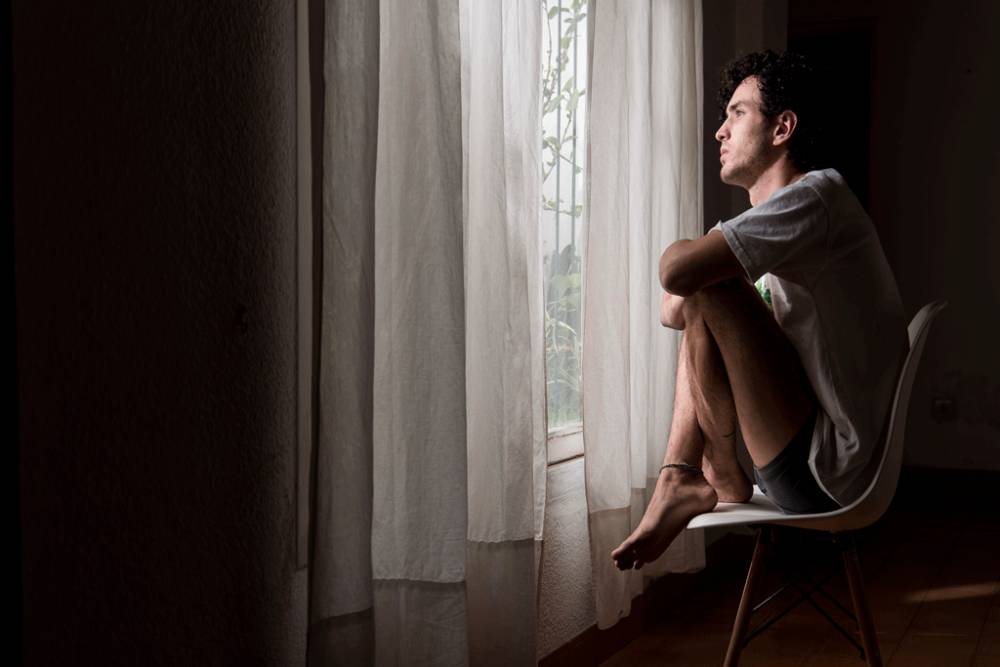
Apparently, seclusion is addictive, or at least solitude is. While short term solitude is very common and basically a medium of helping oneself get rid of traumas and mend things through social withdrawal, there will be arguments about the types and forms of solitude, and whether or not solitude is more influential with all the negativity it possesses (as in castaways and marooned). Alternatively, perhaps, it might possess no positivity at all. From its therapeutic uses, the positive psychological impacts of solitude have been observed and it has been used consistently over the course of time. Therefore, solitude is not an entirely negative concept after all. In fact, the negative impacts of seclusion/solitude are directly related to the longevity of the process, and hence short-lived, self-enforced solitude is found to cause no harm and is rather beneficial. Solitude is generally perceived as a behavior that has its roots in the temporal isolation from social circles. However, its definition is surely not limited to that sphere. In addition, as far as the present human society is concerned, its implications have drastically deviated, modified or maybe an improvisation has occurred over the course of time.
My personal experiences with solitude can be assumed something like a "pseudo-seclusion". It is not that basic "social withdrawal" or any such attempt. The ways solitude can be defined to have stretched beyond the otherwise confined views. Now, there are a number of other entities we can personally distance ourselves from. Hence, experiencing solitude is possible even without seclusion from society, even without distancing ourselves from people. "Loneliness" defines the state of being idled despite being surrounded by people around, so that does not count as a "pseudo-seclusion". Hence, it makes sense when it is defined as “being secluded within a mass”. Experiencing solitude with a bunch of people that have been doing the same because of their inability or choice (forced or voluntary) to carry on with their regular social life can be assumed a "pseudo-seclusion". Being deprived of something (for a long enough period) we thought was quite a necessity may give us a feeling that we can live without them. On the other hand, they were not as important we thought they were.
For today's social scenario, at the very basic levels," pseudo-seclusion" may be manifested via a long enough detachment from electronics and social networking, a lengthy absence of conversation with people we normally tend to allocate certain time from our everyday schedule. Likewise, refraining from meeting peers over the course of time(which again comprised our schedule), finding a whole new bunch of people and making shallow conversations, sharing more personal stories of ourselves, concentrating on some different duties or work(which aren't our normal routine) rather than spending time over the internet, television or the radio(or even newspapers). Furthermore, enveloping chemistry with monotony (since we are in a state of solitude, there is no external addition of dynamism), and sometimes, complying with determinism.
Though the definition of solitude might suggest diminished vigor and activity, being in a “pseudo-seclusion” can in fact increase the tendency to get things done. This might be down to the fact that being in such an environment where the strength of external factors have quite deceased can be encouraging and motivating. Maybe the boundaries prevail, but there still lies a possibility of involving ourselves in activities within that boundary which can end up bringing positivity inside us. People tend to work better when the incentives are strong. Therefore, solitude can work as an incentive and therefore increase the adhesion towards some forms of activities.
Travelers experience exactly the same kind of “pseudo-seclusion” that is being described here. However, this proposition materializes with a dichotomy. While from one perspective traveling is in fact a subject of bigger social attachment, and a more efficient platform for establishing broader social involvements and experiences, from the other side, it is an epitome for “pseudo-seclusion”. The newfound solitude in the travelers is the incentive behind the energy that keeps them moving, and sometimes, the proactivity they possess.
Solitude is covetous. At least, it makes people such. There will always be some lingering whenever people arrive at a point where they have to give up that “pseudo-seclusion” for their usual routine lives. It is a fact: lengthy solitude comes with destructive psychological impacts. Moreover, given the lives of people, withdrawal from the social circles may not be a viable option. Therefore, “pseudo-seclusion” becomes an interesting opportunity (if it is not a forced social detachment); a short-lived positive experience, and sometimes a revitalizing sensation. It might as well be a momentary drift from one’s fundamental beliefs or Psychological Determinism and an opportunity to expand themselves to a broader spectrum of possibilities that can only be realized within an environment that experiences freedom within some confinement. It works as an incentive, and a method to experiment with the adaptability of oneself. As a means of brief disjunction from mainstream monotony (while monotony itself is a major characteristic of “pseudo-seclusion”, it is rather a positive one in this case), and a temporary detachment from continuum for the physical, as well as psychological replenishment of all the human elements that become sapped because of prolonged social exposure over the course of time.
Keywords: Human Behaviour, Psychology, Lifestyle